
Events
Upcoming Events
-
Speaker: Vladimir A. Yerokhin (Max Planck Institute for Nuclear Physics, Heidelberg, Germany)
Host: Jonathan Home
When & where: Friday, 2 October 2026, 10am in HPF G6, Campus Hönggerberg, ETHZ
Title: Higher-order effects in isotope shifts
Abstract: The isotope shifts (IS) of atomic spectra can be measured and theoretically calculated with high accuracy, and are therefore widely used for determining differences in the nuclear mean square charge radii of isotopes. A proper understanding of higher-order IS effects becomes essential at the level of precision of modern radius determinations.
Another pressing need for their systematic studies has recently emerged in the context of new-physics searches based on nonlinearities of King plots [1-4]. A King plot is a graphical representation of IS’s for (at least) two transitions across several isotope pairs. Since it is expected to be linear to very high accuracy, it has been proposed [5] that a hypothetical new-physics boson coupling electrons and neutrons could manifest itself as a small deviation from its linearity. However, a number of “old-physics” effects also induce King-plot nonlinearities.
Reliable theoretical understanding of these effects is therefore essential for interpreting observed deviations from linearity [1-4]. In my talk I discuss the theory of the higher-order field-shift and mass-shift effects in atomic spectra, which are required for interpretation of King-plot nonlinearities.
References
[1] I. Counts et al., Phys. Rev. Lett. 125, 123002 (2020)
[2] J. Hur et al., Phys. Rev. Lett. 128, 163201 (2022)
[3] A. Wilzewski et al. Phys. Rev. Lett. 134, 233002 (2025)
[4] M. Door et al. Phys. Rev. Lett. 134, 063002 (2025)
[5] J. Berengut et al. Phys. Rev. Lett. 120, 091801 (2018) -
-
Other Selected Events Relevant to NCCR Precision
Past Events
-
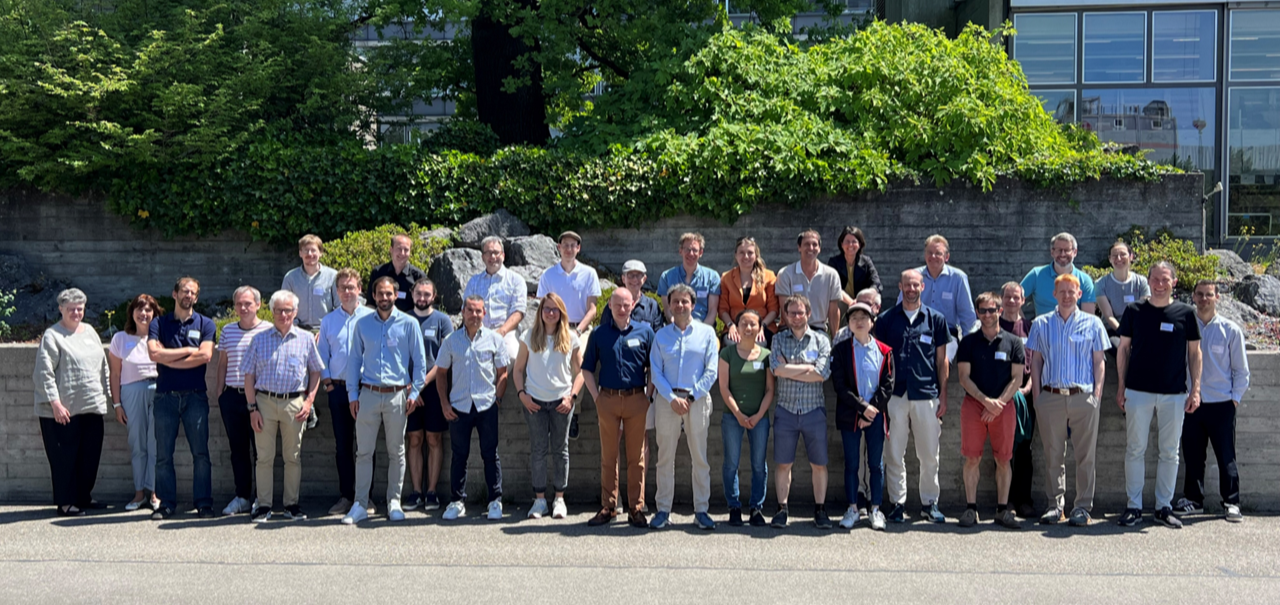
The National Centre of Competence in Research (NCCR) Precision kicked off on 28 May 2026 when it’s 33 principal investigators from across Switzerland gathered for its first meeting.
The inaugural meeting in Zurich brought together participants from the two home institutions, ETH Zurich and the University of Basel, along with collaborators from the Paul Scherrer Institute, EPFL, the Federal Institute of Metrology (METAS), the University of Neuchâtel, and CSEM. This gathering marked the starting point for a nationwide collaboration that integrates expertise from across Switzerland and lays the foundation for future advances in precision science and technology.
-
Speaker: Monika Schleier-Smith (Stanford University)
Host: Tilman Esslinger
When & where: 18 June 2026, 2pm in HPF G6, Campus Hönggerberg, ETHZ
Title: Decoded Quantum Sensing with Cavity-Coupled and Dipolar Spins: From Graph States to Schrödinger Cats
Abstract: Entanglement offers a route to improving precision spectroscopy by enhancing sensitivity to perturbations. A paradigmatic approach is to engineer collective entangled states, such as squeezed spin states or Schrödinger’s cat states, that are sensitive to global fields. To expand the impact to a wider range of sensing tasks and targets, we are augmenting this standard toolbox in two complementary directions. On the one hand, converting global entanglement to spatially structured entanglement opens opportunities in multiparameter sensing. We explore this direction in an array of atomic spin ensembles in an optical resonator, where combining the native collective squeezing operations with local addressing provides flexibility for engineering the graph of entanglement. In contrast with this highly engineered setting, we alternatively harness the native dipolar interactions in an array of Rydberg atoms to generate Schrödinger-cat-like collective entangled states. In both cases, the same interactions that generate correlations also aid in decoding the interferometric signal. We demonstrate the benefits of such decoding for achieving robustness to detection errors and for accessing nonlocal observables that allow for evading quantum uncertainty bounds. I will also touch on broader implications of our advances in control of long-range interactions and entanglement for quantum simulation and computation. -
Speaker: Roberto Menta (NEST, Scuola Normale Superiore, Pisa, Italy)
Host: Tilman Esslinger
When & where: Friday, 17 July 2026, 4pm in HPF G6, Campus Hönggerberg, ETHZ
Title: Universal quantum computation and error correction with global control
Abstract: We propose a globally-controlled quantum computing architecture based on a ring of qubits coupled via nearest-neighbour XY interactions, requiring only a single locally driven qubit and two global control channels. Information is transported around the ring via global dynamics, while universality is achieved by routing qubits to the local control site for single- and two-qubit gates. To address the reduced gate parallelism inherent to global control, we identify a family of cyclic stabiliser codes whose syndrome extraction circuits are natively parallel and match the loop topology. Using memory experiment simulations, we find a QEC threshold around a physical error rate of 10⁻⁴, requiring only a single measurement site. This establishes one of the most resource-efficient routes to error-corrected globally-controlled quantum computation to date.
-
Speaker: Piet O. Schmidt (Physikalisch-Technische Bundesanstalt, Braunschweig + Leibniz Universität Hannover)
Host: Jonathan Home
When & where: Thursday, 6. August 2026, 11:00-12:00, HPF G6, Campus Hönggerberg, ETHZ
Title: Quantum Engineering Optical Clocks Based on Trapped Ions
Abstract: Optical atomic clocks with eighteen significant digits are the most accurate measurement devices available to us with applications ranging from tests of fundamental physics to height difference measurements in relativistic geodesy. The uncertainty in trapped-ion clocks is limited by systematic frequency shifts and quantum projection noise. I will show how quantum engineering techniques can overcome these limitations. Quantum logic spectroscopy provide access to clock species such as Al+ and highly charged ions with reduced systematic shifts. Dynamical decoupling and entangled state spectroscopy in a multi-ion frequency reference offer suppression of systematic shifts, while improving the signal-to-noise ratio of the clock and thus the required averaging time to reach a certain resolution. These developments will pave the way towards a next generation of quantum-enhanced clocks that enter the 10-19 relative frequency uncertainty regime.
-
Speaker: Julian Léonard (The Institute of Science and Technology Austria (ISTA))
Host: Tilman Esslinger
When & where: Friday, 21 August 2026, 11am in HPF G6, Campus Hönggerberg, ETHZ
Title: Atomic tweezer arrays strongly coupled to light
Abstract: Strong atom–photon interactions in optical cavities provide a key resource for cavity-mediated many-body physics, quantum information processing, and quantum networking. Optical tweezer arrays offer scalable, site-resolved control of neutral atoms, but their integration with high-cooperativity cavity QED systems has been an outstanding challenge. I will report on our recent experiments, where we achieve this long-standing goal. The setup integrates three ingredients: single atom control for arbitrary quantum logical operations, a tweezer-cavity system for cavity QED, and a fiber interface for real-time measurements.
Our results open a path to programmable interactions within an atomic tweezer array, to non-destructive readout protocols, and to implementing quantum network protocols.
-
Speaker: Daniel González-Cuadra (Institute for Theoretical Physics UAM/CSIC)
Host: Tilman Esslinger
When & where: Tuesday, 15 September 2026, 4pm in HPF G6, ETH Hönggerberg campus
Title: Simulating fermionic matter on quantum devices: from fermions to qubits and back
Abstract: Performing large-scale, accurate quantum simulations of many-fermion systems is a central challenge in quantum science, with applications in chemistry, materials science, and high-energy physics. This can be approached using either native fermionic simulators or qubit-based quantum computers, each with distinct advantages and limitations. While the latter can simulate more general models, generic fermionic algorithms incur a significant space-time overhead compared with native fermions, scaling as O(N) for N fermionic modes.
In the first part of the talk, I will present a method for faster fermionic simulation on qubit devices with non-local connectivity, such as neutral-atom arrays, reducing the asymptotic space-time overhead to O(log N) in the worst case and O(1) for circuits with additional structure [1]. These techniques include the fermionic fast Fourier transform and enable efficient state preparation and Hamiltonian simulation of materials and molecules. In the second part, I will discuss how, while these results tightly bound the computational gap between fault-tolerant qubit and fermionic hardware, native fermions offer important advantages in the near term. In particular, I will show how recent experimental advances allow to operate cold-atom systems as programmable devices capable of running advanced quantum algorithms, overcoming key limitations of the standard analog approach, as illustrated by quantum phase estimation [2].[1] arXiv:2509.08898 (2025)
[2] arXiv:2511.04434 (2025)
-
Speaker: James Greenberg (IMRA America, Inc. Boulder Research Labs)
Host: Giacomo Scalari
When & where: Friday, 18 September 2026, 11am in HCI D4, Campus Hönggerberg, ETHZ
Title: Photonic terahertz generation and applications
Abstract: Exploring the limits of spectral purity in the terahertz domain leads to photonic solutions. In this talk I will introduce IMRA's Dual Wavelength Brillouin Laser (DWBL), a tunable source of low-noise continuous-wave THz radiation, and photonic concepts like stimulated Brillouin scattering, optical injection locking, and photomixing. I will also discuss metrological characterization of the DWBL with a primer on phase noise and Allan deviation. Then, I will connect these measurements to a few applications. Namely, wireless communications, molecular rotational spectroscopy, and injection locking amplification.